
Queen’s has its tricolour, Western has its Mustangs, and Laurier has its purple and gold. But at UofT, Homecoming has never quite become the same university-wide tradition. Now, Delta Upsilon is hoping to change that, and The Row went to see what all the excitement was about.
It’s that time of year again. Your Instagram stories are flooded with students dressed head to toe in university colours, football stadiums packed with screaming fans, and groups of friends reuniting for what might be the most anticipated weekend of their academic calendar.
At Queen’s, it’s tricolour everything. At Western, the Mustangs take over London. At Laurier, Waterloo turns purple and gold. Meanwhile, at the University of Toronto, students are probably wondering whether Robarts is open until 2 a.m. or 24 hours tonight.
So, where exactly is our Homecoming?
For students across Ontario, Homecoming, or Hoco, is practically a cultural institution. It’s a weekend of reunions, athletic pride, longstanding traditions, and, of course, an excuse to put the textbooks down and celebrate being a university student.
But at UofT, where university life often feels scattered between lecture halls, college communities, and the surrounding streets of downtown Toronto, that same tradition has never quite taken hold at St. George.
At least, not yet.
Because this fall, one fraternity decided that perhaps it was time to give UofT students something to celebrate.
And judging by the line outside Delta Upsilon’s doors, students were more than ready.
How Did Homecoming Become a Thing Anyway?
Believe it or not, Homecoming didn’t begin as an excuse for university students to spend an entire weekend celebrating.
The tradition emerged from a much simpler idea: bringing graduates back to the place where their university experience began.
Its exact origins are debated, with several American universities claiming a place in Homecoming history. Baylor University in Texas organized a celebration in 1909, inviting former students back for reunions and festivities. The University of Illinois established its own tradition in 1910, while the University of Missouri’s 1911 celebration helped popularize the familiar combination of football and school spirit.
The idea was straightforward. Universities wanted graduates to return, reconnect, and maintain a lifelong relationship with their alma mater. Football provided a convenient reason for everyone to gather in one place.
Over time, Homecoming developed a life of its own, evolving from an alumni-focused reunion into an annual celebration shared by current students, graduates, and entire university communities.
Canada was quick to embrace the idea.
The University of Guelph traces its Homecoming football tradition back to 1923, when the Ontario Agricultural College organized a game between graduates and current players.
Queen’s University held its first official reunion week in 1926, bringing graduates back to Kingston for eight days of festivities, culminating in a football game against none other than the University of Toronto Varsity Blues.
Yes, UofT was involved in one of the earliest Canadian Homecoming traditions.
Somehow, a century later, we’re the ones watching everyone else’s celebrations through Instagram.
The Ontario Universities That Understood the Assignment
If you’ve ever visited friends at Queen’s, Western, McMaster, Guelph, or Wilfrid Laurier during Homecoming, you’ll know that it’s more than just another weekend on the university calendar.
It’s practically a personality trait.
Queen’s University: A Century of Tricolour Pride
Kingston might be a relatively quiet university city for much of the year, but Homecoming brings generations of Queen’s students and alumni back to campus.
The tradition is especially significant in 2026, as Queen’s prepares to celebrate 100 years since its first official Homecoming.
The weekend features alumni reunions, campus festivities, and the Gaels football game, with generations of graduates returning to reconnect with their university.
It’s one of the few occasions when someone who graduated 50 years ago might find themselves celebrating alongside someone who has barely survived their first midterm season.
Western University: Mustang Country
At Western, Homecoming is practically synonymous with purple-and-white outfits, football, and school spirit.
The university’s 2026 celebrations brought together alumni, students, faculty, and families for a weekend of reunions, campus tours, and a Student Fan Festival.
While football remains a major attraction, the social culture surrounding the weekend is just as recognizable.
For many students, Homecoming is an opportunity to reconnect with friends and experience the kind of collective university pride that extends well beyond the stadium.
McMaster University: Homecoming, but Make It a Festival
McMaster has taken a particularly student-focused approach to its celebrations.
In 2025, the university and McMaster Students Union organized a day of festivities featuring food trucks, outdoor games, a foam party, and a Marauders football game against Guelph.
The evening’s headline attraction? A concert featuring Lil Yachty.
Rather than treating Homecoming exclusively as an alumni reunion, McMaster has made it a significant event for current students.
And really, who wouldn’t appreciate a university-sanctioned reason to put their readings aside?
University of Guelph: Gryphon Pride Since 1923
Guelph’s Homecoming tradition stretches back more than a century, beginning with a football game intended to strengthen connections between the university and its graduates.
Over the years, Homecoming festivities have included parades through downtown Guelph, athletic events, alumni gatherings, and campus celebrations.
It’s become a defining part of the Gryphon experience, connecting generations of students through an annual tradition that long predates most of their grandparents.
Wilfrid Laurier University: Purple, Gold, and Waterloo
At Laurier, Homecoming combines athletic pride with a recognizable student social culture.
Its 2026 celebrations included a pancake breakfast, student activities, and the Golden Hawks football game against York.
The university’s traditions have become a major part of the Waterloo student experience, with students and alumni celebrating their connection to the Golden Hawks year after year.
And although these universities celebrate differently, they all have something in common.
Homecoming gives students a shared experience that becomes part of their university’s identity.
Which brings us back to Toronto.
So, Why Doesn’t UofT Have a Hoco Like That?
Technically, the University of Toronto does celebrate Homecoming.
Just not necessarily the version students are imagining.
UofT Scarborough hosted a Homecoming celebration in September 2025 featuring live performances, food trucks, a talent showcase, and even a drone light show.
The university also holds an annual Alumni Reunion. In June 2026, UofT organized more than 140 events across its three campuses, inviting graduates back for celebrations, tours, and reunions.
Clearly, UofT isn’t opposed to celebrating its history.
What seems to be missing, particularly at St. George, is the massive, recognizable, student-oriented fall tradition that defines university life elsewhere in Ontario.
Part of that difference might come down to geography.
Unlike Queen’s in Kingston or Western in London, UofT operates in the centre of Canada’s largest city. Students are spread across three campuses, multiple colleges, and countless neighbourhoods, with many commuting into Toronto rather than living together in a concentrated student district.
University social life is often organized around smaller communities.
A student at Victoria College might have an entirely different experience from someone at University College, Trinity, or St. Michael’s.
Between college orientations, student clubs, athletics, and Greek life, there are countless opportunities to get involved. But those communities don’t always come together under one shared university identity.
At schools with established Homecoming traditions, the weekend gives students something to celebrate collectively, regardless of their faculty, residence, or friend group.
For a few days, everyone is cheering for the same team, wearing the same colours, and participating in something bigger than their individual social circles.
At UofT, that collective moment can be harder to find.
But Delta Upsilon seems to think there’s room for one.
Delta Upsilon Wants to Bring Hoco to UofT
While most UofT students have grown accustomed to hearing about their friends’ Homecoming experiences elsewhere, Delta Upsilon (DU) is hoping to establish something similar at St. George.
And the idea didn’t appear out of nowhere.
In 2025, DU and Zeta Psi collaborated on a Homecoming-related initiative, an early example of how Toronto’s Greek organizations could work together to develop the tradition.
Both fraternities have remarkably long histories at UofT. Zeta Psi established its Toronto chapter in 1879, becoming the first fraternity in Canada, while Delta Upsilon’s Toronto chapter was founded in 1899.
These organizations have been part of university life for well over a century.
Now, DU is looking toward the future.
The question is whether an institution known for its academics, rather than its school spirit, can develop the same kind of Homecoming enthusiasm seen elsewhere in Ontario.
Well, if this year’s celebration is anything to go by, the answer might be yes.
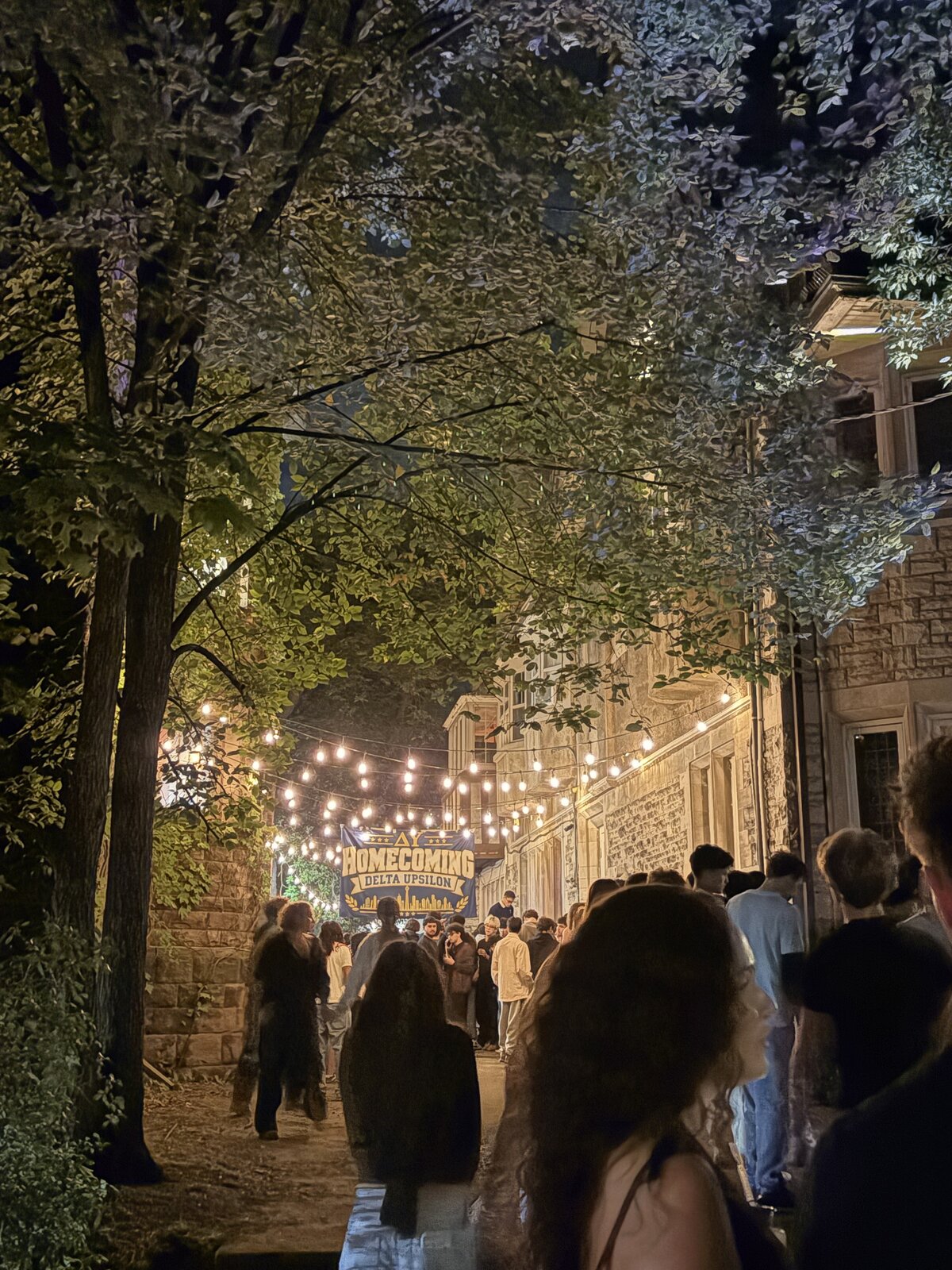
10:05 P.M. and Already a Line: Inside DU’s Homecoming 2026
If there was ever any doubt that UofT students wanted a Homecoming of their own, Delta Upsilon’s Fall 2026 celebration offered a pretty convincing answer.
The Row attended DU’s Homecoming party to see firsthand whether the excitement surrounding the event lived up to the promise.
Officially, the party began at 10 p.m.
By 10:05, a crowd had already gathered outside the fraternity’s doors.
By 10:40, the line had wrapped around the block, with students patiently waiting for their turn to join the festivities.
And remarkably, despite the growing numbers, the atmosphere remained orderly.
It was a sea of blue, black, and white outfits, with students dressed for what felt like one of the most anticipated nights of the semester.
From the back of the crowd, flashes of purple light illuminated the scene. A live DJ commanded the centre of it all, the music carrying through the party as the energy continued to build.
The atmosphere was electric.
In fact, even The Row’s staff found it difficult to maintain their usual professional composure.
It’s one thing to attend an event with the intention of documenting student life. It’s another to find yourself completely caught up in the very excitement you’re supposed to be observing.
For a moment, it didn’t feel like UofT was missing out on anything.
Students were celebrating together, dressed in school colours, embracing the kind of collective excitement that often seems reserved for Frosh Week or universities with much more established Homecoming traditions.
It felt like the missing piece of UofT’s first-year celebrations had finally fallen into place.
Think about it.
Frosh Week introduces students to university life, but what happens after the orientation leaders pack up, the wristbands come off, and everyone settles into their routines?
At other universities, Homecoming offers a second opportunity to recreate that early-semester excitement, bringing students together again after the initial rush of September.
And at a university as academically demanding as UofT, perhaps students need that opportunity more than they realize.
What made DU’s celebration particularly striking wasn’t simply the turnout.
It was the enthusiasm, the coordinated colours, and the feeling that students were participating in something larger than their usual weekend plans.
For a university frequently criticized for its fragmented social scene, seeing that level of collective spirit was refreshing.
But as the line continued to grow, another question became difficult to ignore.
If one fraternity could attract this much attention, what would happen if Homecoming became a university-wide tradition?
And more importantly, could the Annex handle it?
The Annex Has Entered the Chat
Take a walk north of campus, past the towering academic buildings and onto the tree-lined residential streets of the Annex, and you’ll find something that almost feels out of place in downtown Toronto.
Grand Victorian and Edwardian homes, beautiful stone façades, sprawling porches, and the occasional set of Greek letters displayed proudly above a front door.
Many of these properties have stood for over a century, housing fraternity and sorority organizations whose histories stretch back generations.
DU’s home at 182 St. George Street, for example, was completed in 1911 and retains historic architectural features protected by heritage designation.
These buildings are not simply party venues. They’re residences, meeting places, and pieces of Toronto’s architectural and university history.
But the Annex isn’t exclusively a student neighbourhood.
Those charming streets are also home to longtime residents, families, schools, child-care programs, and other community institutions.
And not every neighbour is particularly enthusiastic about living beside a fraternity house.
The relationship between Toronto’s Greek organizations and the surrounding community has occasionally been contentious, particularly when it comes to noise, garbage, and large gatherings.
In 2018, Toronto City Council reviewed fraternity and sorority housing regulations after neighbourhood complaints. The discussion resurfaced in January 2024, when Councillor Dianne Saxe proposed reconsidering an exemption from the city’s multi-tenant housing licensing requirements.
That proposal was not adopted, but the debate demonstrated that fraternity housing remains a subject of municipal scrutiny.
This is where the prospect of a massive, university-wide Homecoming becomes complicated.
A celebration that grows into an uncontrolled street gathering could congest the narrow residential roads, interfere with traffic, strain relationships with neighbours, and invite renewed calls for tighter regulations.
And while no councillor can simply decide to abolish Greek life, a badly managed event could create political pressure that affects more than just its organizers.
There are historic homes to preserve, residents to consider, and decades of community relationships that could be jeopardized by one afternoon of chaos.
For Greek organizations that have survived generations of change, that’s a considerable amount to put on the line.
The challenge, then, isn’t necessarily making Homecoming bigger.
It’s making sure that something worth celebrating doesn’t become something that threatens the very community organizing it.
So, How Do You Throw a Hoco Without Getting Greek Life Shut Down?
Well, for starters, perhaps don’t try to recreate Aberdeen Street in the middle of Toronto.
One of the most encouraging details from DU’s 2026 celebration was that, despite the line wrapping around the block, the crowd The Row observed was orderly.
It’s an important distinction.
Large student gatherings don’t automatically have to become chaotic, and school spirit doesn’t need to come at the expense of the surrounding neighbourhood.
But transforming a fraternity-hosted event into a university-wide tradition would require a larger plan.
Partnerships with Varsity Blues athletics, student organizations, alumni groups, and appropriate event venues could help create celebrations that extend beyond individual fraternity properties.
More importantly, a successful UofT Homecoming would have to appeal to students outside Greek life, too.
The beauty of Homecoming at other universities is that participation isn’t dependent on being a fraternity member, an athlete, or a residence student.
It’s an opportunity for the entire university to celebrate.
DU and Zeta’s collaboration last year offers an example of how organizations can begin working together rather than operating independently.
Perhaps the next step is an expanded celebration involving additional chapters, campus clubs, and student groups.
Maybe it begins on a relatively small scale and grows over several years.
Whatever the format, the goal should be something students can look forward to annually, rather than a one-night event that disappears when its organizers graduate.
After all, traditions have to start somewhere.
Something Worth Coming Home To
There is something genuinely exciting about the possibility of establishing a new tradition at the University of Toronto.
For an institution approaching two centuries of history, St. George can sometimes feel strangely disconnected from the collective student experiences that define campus life elsewhere.
The academic reputation is there. The athletics are there. The student organizations are certainly there.
What’s missing is that one fall weekend when everyone feels like they’re part of the same university.
And if DU’s celebration proved anything, it’s that the enthusiasm is already there.
The next step is turning that enthusiasm into something that lasts.
After all, what’s the point of Homecoming if there’s nothing worth coming home to?